

No products in the cart.

Can ringworm make you sick?
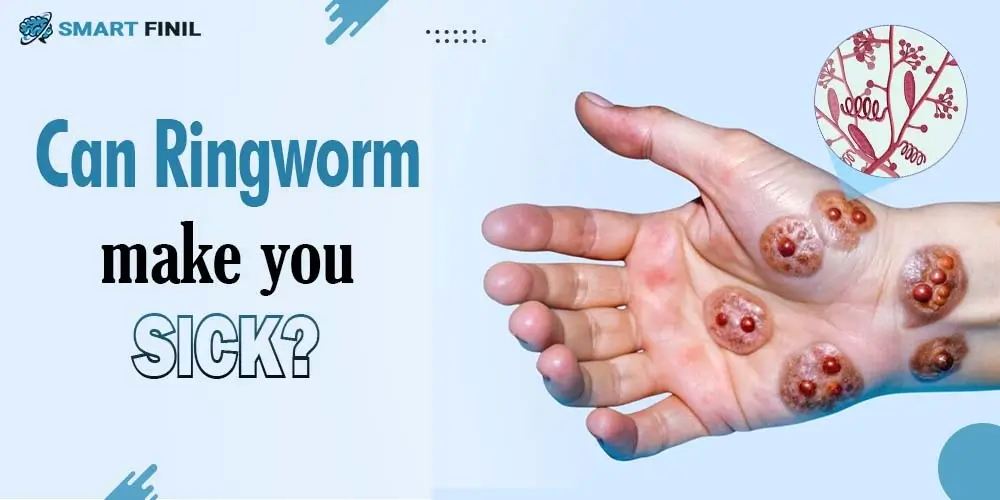
Ringworms may make you feel a little uncomfortable, but they won’t make you feel sick. Ringworms are not caused by worms, but are a fungal skin infection that majorly affects the scalp, skin, feet, and groin.
Common kinds of ringworms may include Tinea corporis, Tinea capitis, Tinea cruris, Tinea pedis, and Tinea unguium. The medical name of ringworms is Tinea infection. Individuals with diabetes, excessive sweating, weaker immunity, and those in old age are at higher risk.
What is Ringworm?
Ringworms are caused by fungal infections. These are circular and itchy red rashes that have a clear skin-like appearance in the middle. Worms are not involved in these kinds of infections.
Symptoms of ringworms
Common signs and symptoms of ringworms may include the following:
- Scaly and ring-shaped areas, particularly on the trunk, buttocks, legs, and arms
- Itchiness all over
- Scaly and clear area within the ring indicated by bumps scattering, color ranging from red to white skin to purple, red, gray, brown, and black skin.
- Expanding skin that is slightly raised
- Flat and round patches on the itching skin
- Overlapping of the rings
How do you get ringworms?
Ringworms, caused by fungus, can spread from one to another. The mold-like parasites surviving on cells on the skin’s outer layer are the primary causes of the condition. Here are some of the most common ways in which ringworm spreads:
Human to human: Direct and skin-to-skin contact with an individual who has been infected is responsible for the occurrence and growth of ringworms.
Animal to human: If an animal has ringworm, and an individual happens to touch it, ringworm may spread.
Stages of ringworm
Ringworms usually develop into two major stages and spread over the duration of 1-2 weeks. Caused by fungus, the appearance of ringworms is visible in 4-14 days after being exposed as a scaly and dry patch that further tends to expand towards the outside.
Three stages of ringworms may include:
Incubation stage: It is an early and initial stage. The appearance of fungus takes place 4-10 days after the exposure. Symptoms of the ringworms begin as a dry, itchy, small, pink, and red patch. The appearance of the ringworm at this stage may not look like a ring but like scaly and irritated skin.
Second stage: This is the active and growth stage, with the lesion expanding outwards. The development of ringworms happens as scaly, raised, red patches with a border, such as a blister. At this stage, the patients can see the ring-like appearance. Skin will feel a little more itchy and present a burning condition, with the possibility of multiple ring formations and appearances.
Healing stage: The infection gradually clears up at this stage if a good antifungal treatment has started. After starting the ringworm medication, improvements may be seen in 2-5 days. Complete healing of the ringworm may take 4 weeks or more.
What do ringworms look like?
Ringworms are a contagious kind of fungal infection that may lead to a ring-like and circular pattern that forms on your skin. Interestingly, in ringworm infections, there are actually no worms involved. These are usually harmless skin infections that are caused by the presence of fungus.
5 early signs of ringworm infections
Ringworm infections are not caused by worms, but by a fungus that may survive on the hair, skin, and nails. Ringworm infections spread fast through the sharing of personal items, skin contact, and contaminated surfaces.
Here are some of the top and early signs of ringworm infections:
Red and circular rashes: These are red ring-shaped signs that start with a scaly and flat patch on the skin. The expansion is outwards, with the center clearing up. Edges may be blistered and bumpy. Ringworms may appear anywhere on the body, but most of them are found on the legs, arms, torso, etc. These are often mistaken for eczema or some kind of infection.
Irritated and itchy skin: The area affected becomes extremely itchy during the night, leading to worse irritation and secondary bacterial infection. When scratching breaks the surface of the skin, there is room for bacteria to enter and further complicate the condition.
Cracked or scaly skin: When the infections progress, the skin can further turn into something rougher and scaler. Flaking, peeling, and cracking are very common in these conditions. In certain areas, like the feet, skin present between the toes may become scaly and dry. Cracked skin may cause discomfort, which may not improve with the use of moisturizers, too.
Bald patches: Tinea capitis, which is a scalp condition that occurs with the invasion of ringworm. Thinning patches and baldness are the result indicated by scaling, redness, and black dots.
Thickening and nail discoloration: Not just the skin, the ringworms may also infect other parts of the body, such as toenails and fingernails, etc. This concern is commonly known as onychomycosis and tinea unguium. The condition may be tough to treat and may get worse with time. The nails that are infected may become brittle, thick, and discolored. Crumbling of the nails is possible. The condition may require months of treatment.
Is ringworm contagious?
Yes. Ringworms are highly contagious. Skin-to-skin contact with the infected pets and humans may help it spread. The infection may also spread through infected bedding, contaminated surfaces, and clothing. It is not a worm infection but a fungal infection.
Here is some more information on the Contagion:
Route of transmission: Spreading of the infection happens through human-to-human and may also happen from animal to human. Infection may commonly spread from animals like dogs and cats, and in rare cases, from contaminated soil.
The Contagious duration: The ringworms are contagious until the rashes have healed completely. 48 hours after the treatment has started, the ringworms become non-contagious.
Prevention: Personal items like combs and towels must not be shared. Skin should be kept dry and clean. Pets with patchy hairy loss should not be touched.
How long does ringworm last?
Ringworms may last for 2-4 weeks after a good antifungal treatment has been started. It may take 2 months for the mild infections to clear up, but infections that affect the nails and the scalp may take 3 months to completely heal. If you find no improvement after 2 weeks, consult a doctor.
3-day ringworm treatment
The usual and effective 3-day ringworm treatment may include the following:
Antifungal cream: Creams that contain terbinafine and clotrimazole 200mg may be used twice a day.
Keep clean: The infected area must be kept clean and dry. Moisture may help the fungus spread more and faster. The area that is affected must be cleaned with water and soap. Bedding and towels must be cleaned regularly.
Don’t stop abruptly: Symptoms usually fade in 3 days, but the treatment should be continued for 1-2 weeks so that the possibility of recurrence can be prevented.
How to get rid of ringworm permanently?
Patients suffering from ringworm infection should apply OTC antifungal creams, such as terbinafine and clotrimazole, for 2-4 weeks to prevent spread. You may also use Candid V Gel available on Smartfinil.net for the treatment of ringworm. Here are a few more steps of prevention in ringworm treatment that may help:
Use suitable medications: Use of antifungal creams, powders, and lotions containing components like miconazole, clotrimazole, and terbinafine is recommended as the best medicine for ringworm infection.
Ringworm Treatment time: For ringworm, the suitable cream should be applied regularly for 1-2 weeks until the skin appears normal again and all fungi have been eliminated.
Re-infection: Re-infection should be stopped by washing clothes, towels, and bedding in hot and clean water.
Dry skin: Dry skin is safe and prevents the ringworm spread, as it survives in moisture.
Medical advice: Seek medical consultation if the infection does not clear up in 2-4 weeks. Oral antifungals and prescription-strength creams must be used on medical advice.
Steroids: Use of steroids is not recommended. Avoid steroid creams and hydrocortisone, as the infection may become worse.
Scratching: Do not scratch, as the ringworm may spread into other body parts, increasing the possibility of secondary infections.
Conclusion
In most cases, people don’t feel sick often and are not even feverish. Severe infection is possible in children, senior citizens, and those with weaker immunity. Severe infections may cause pus, pain, swelling, and mild fever. Ringworm infection may be treated with ringworm medicine.
FAQ:
Is ringworm dangerous?
Ringworms are not usually life-threatening or dangerous. However, these are uncomfortable and contagious. This superficial fungal infection may be normally and effectively treated with the help of ringworm medication and antifungal creams.
Can ringworm kill you?
No. Ringworm infection will not usually kill anyone. It is a non-lethal and common but easily treated infection affecting the hair, skin, and nails, and can be treated with proper ringworm medicine.
Do ringworms go away on their own?
Small and minor ringworms may be eliminated on their own, but with a lack of proper ringworm medicine or ringworm treatment, it may take months.
How to cure ringworm fast at home?
Use OTC antifungal creams and the best medicine for ringworm containing terbinafine, miconazole, or clotrimazole. These ringworm medications should be utilized twice a day for almost 2-4 weeks.
